




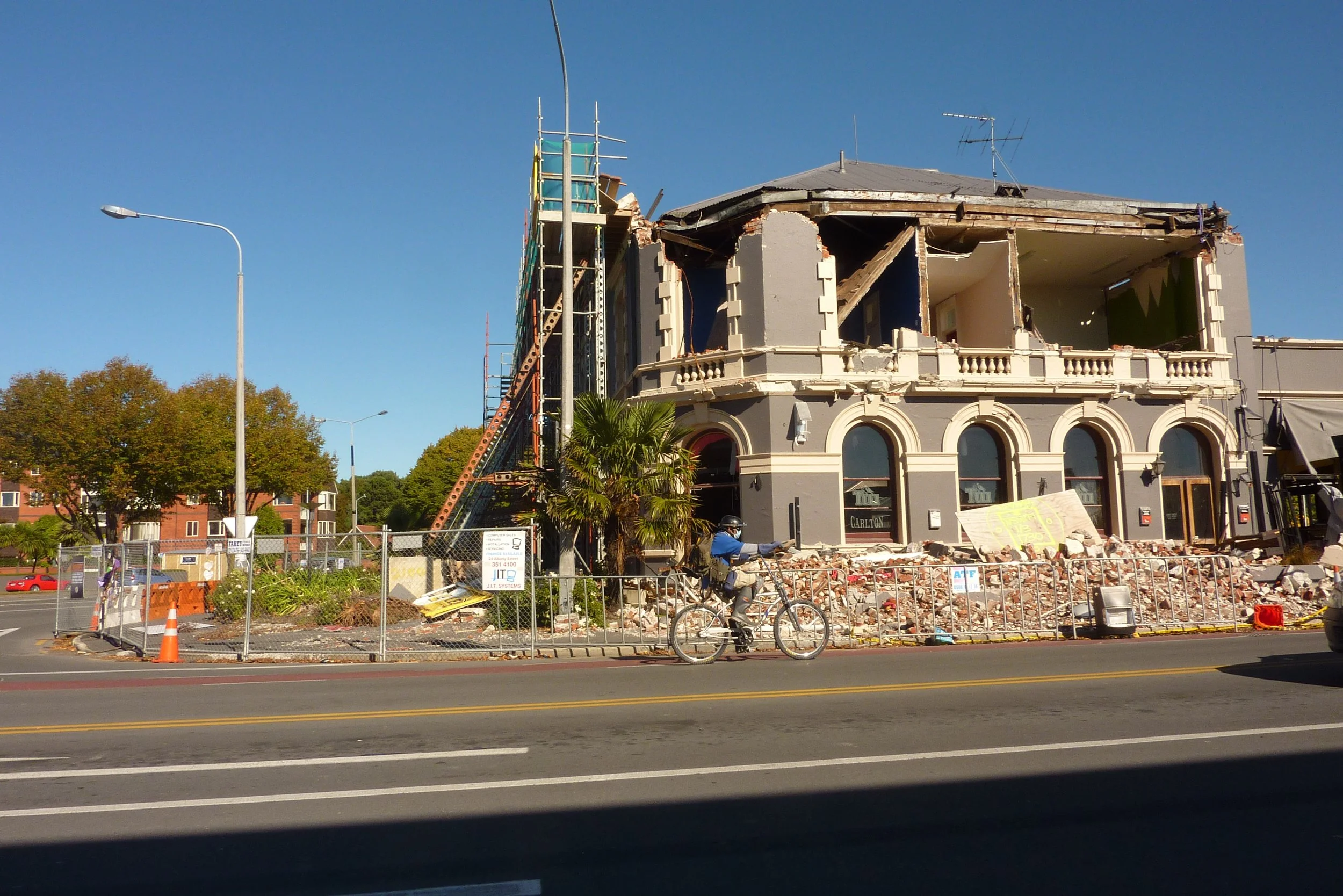
Kiwi solution to strengthen earthquake-prone buildings
Te Whanganui-a-Tara - Research funded by Toka Tū Ake EQC has found wrapping weak spots in concrete walls with carbon-fibre straps can strengthen earthquake-prone high-rise buildings well beyond the demands of the building code.
The research findings by University of Auckland PhD student Victor Li will be presented this week at the New Zealand society for earthquake engineering conference in Auckland.
It is likely to draw significant interest in this sector as more than 100 multi-storey buildings in Wellington’s CBD alone are identified to be well below modern code.
With so many pre-1982 concrete buildings in New Zealand considered a particular earthquake risk, the research by the team supervised by Dr Enrique del Rey Castillo and Dr Rick Henry and funded by Toka Tū Ake EQC, has been in a race against time to find the most efficient and cost-effective ways to strengthen thin concrete walls.
Li says that this type of concrete walls can deform out of plane due to their thinness and inherent instability, and just one per cent of lateral displacement can cause catastrophic collapse.
“Technically it’s called axial failure. It can still happen in a newer building, as we saw in Christchurch’s Grand Chancellor Hotel, but the pre-1982 design methods mean the risk is higher in those older buildings,” Li says.
“Up until now there has been no guidance on how these walls could be strengthened, but our research has shown that with the carbon fibre solution, the wall cannot buckle in the out of plane direction,” says Li, who added that the team tested the walls up to twice the building code for seismic resilience.
Toka Tū Ake EQC head of research Dr Natalie Balfour many older commercial buildings are being converted to apartments, so it is vital to ensure that people live in homes that meet modern earthquake standards.
“Toka Tū Ake EQC decided to fund this research because it will deliver practical guidance on how at-risk walls in older buildings can be strengthened cost-effectively. It will also establish a consistent way of doing these fixes across New Zealand,” she says.
“At the NZSEE conference we will present new guidelines and equations for engineers to use, so they can choose the most efficient and cost-effective fix for their particular problem wall.”
Dr Castillo says his team has had a lot of support from industry players like Concrete NZ, Mapei, Sika, Holmes and BBR Contech who are all extremely interested in the research and to ensure that the testing would deliver real-world results.
Photo: Kip Brook

Lisa was born in Auckland at the start of the 1970s, living in a small campsite community on the North Shore called Browns Bay. She spent a significant part of her life with her grandparents, often hanging out at the beaches. Lisa has many happy memories from those days at Browns Bay beach, where fish were plentiful on the point and the ocean was rich in seaweed. She played in the water for hours, going home totally “sun-kissed.” “An adorable time to grow up,” Lisa tells me.
Lisa enjoyed many sports; she was a keen tennis player and netballer, playing in the top teams for her age right up until the family moved to Wellington. Lisa was fifteen years old, which unfortunately marked the end of her sporting career. Local teams were well established in Wellington, and her attention was drawn elsewhere.