




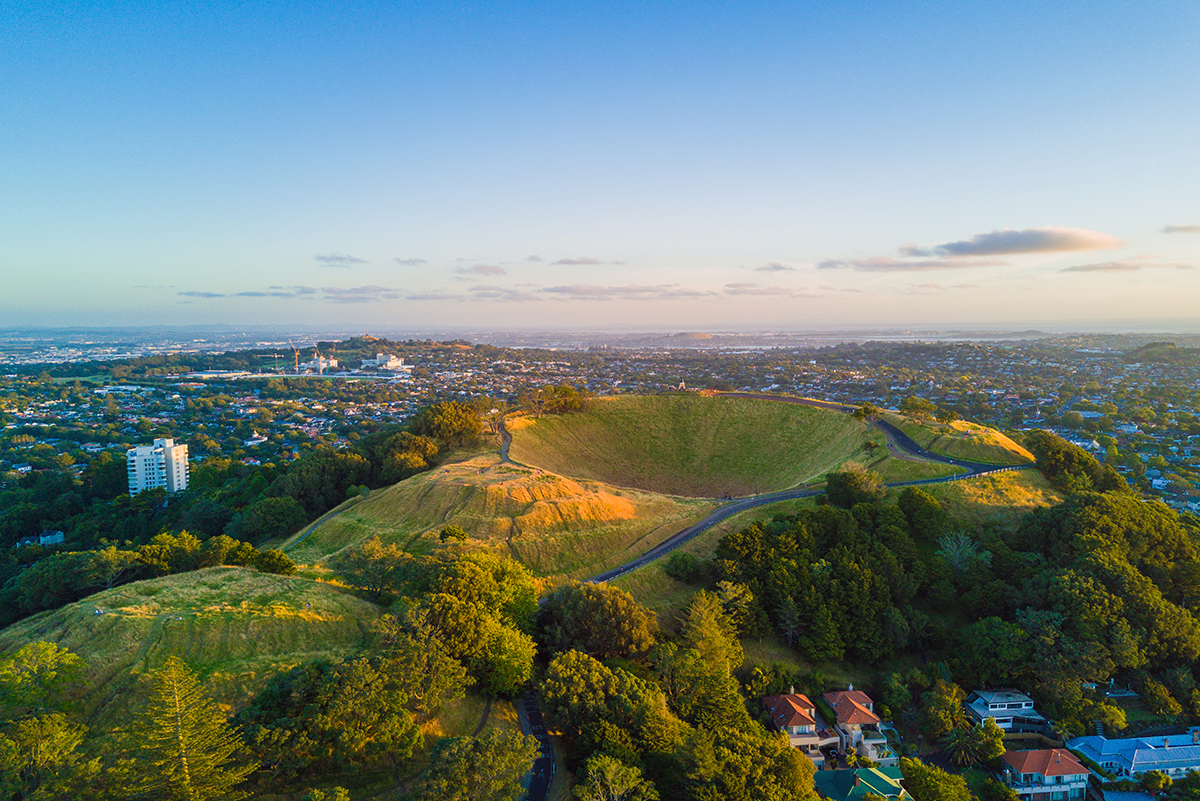
Fibre to help understand earthquakes in Auckland’s volcanic field
Te Whanganui-a-Tara - Researchers will soon start using Auckland’s fibre network to study smaller earthquakes that could help to detect volcanic activity under the city.
Tamaki Makaurau is built on a volcanic field with 53 recognised volcanoes, posing a substantial natural hazard to New Zealand’s largest city.
Previous eruptions have differed in time and location, making it challenging to predict future eruptions in the city.
The 11 Geonet seismometers around Auckland provide good recordings of seismic activity, but the nationwide-focus applied to them does not capture low-magnitude earthquakes, nor the variability that can be used to study the volcanic field.
New research by Victoria University and the University of Auckland will use fibre-optic technology to detect smaller earthquakes of less than magnitude 1.
There is likely to be an eruption sometime in the future and we think that earthquakes might provide some insight into volcanic unrest in the area. Being able to accurately monitor seismic signals is essential to forecast the location and timing of an eruption.
Researchers will use laser pulses to repeatedly measure the length of the cables, allowing them to record stretching in the cables due to passing seismic waves. The method allows them to resolve shaking about every 10 metres along the fibre.
The project will build capability in New Zealand for this important emerging technology, which will provide new ways to detect seismicity wherever communications fibres are installed. The research will create a catalogue of earthquakes in and around Auckland that traditional methods have not been able to locate and characterise accurately.
The teams are working with Australian company FiberSense which have been using this technology to track things like vehicle movements and underground infrastructure issues.
The tools the teams develop will provide high-resolution ways of detecting and monitoring volcanic and seismic hazard in urban environments, not only in Auckland but across New Zealand.
With many cities having fibre networks and undersea fibre cables running offshore, the techniques and technology the team is developing will be hugely useful for getting a better picture of seismic hazard across Aotearoa.
The project will start in April and they will work closely with volcanology and seismology experts from Determining Volcanic Risk for Auckland (DEVORA) and will provide the findings to Auckland Council, Tūpuna Maunga Authority and other key stakeholders.

Lisa was born in Auckland at the start of the 1970s, living in a small campsite community on the North Shore called Browns Bay. She spent a significant part of her life with her grandparents, often hanging out at the beaches. Lisa has many happy memories from those days at Browns Bay beach, where fish were plentiful on the point and the ocean was rich in seaweed. She played in the water for hours, going home totally “sun-kissed.” “An adorable time to grow up,” Lisa tells me.
Lisa enjoyed many sports; she was a keen tennis player and netballer, playing in the top teams for her age right up until the family moved to Wellington. Lisa was fifteen years old, which unfortunately marked the end of her sporting career. Local teams were well established in Wellington, and her attention was drawn elsewhere.